MOBILIZING THE ENTIRE NATION TO BUILD A NATIONAL LOGISTICS INFRASTRUCTURE
Recently, Viettel Post has made numerous new moves, which you refer to as the socialization strategy of logistics infrastructure. What does this mean in simple terms?
Mr. Phung Van Cuong: In our view, socializing logistics infrastructure simply means mobilizing the entire population and society to participate in building the national logistics infrastructure.
Previously, infrastructure projects in energy, telecommunications, and even digital infrastructure were primarily undertaken by the government, large organizations, and entities, without much involvement from the general public. However, we believe that building a national logistics infrastructure can be approached differently.
To better explain this perspective, it’s essential to understand what logistics is. According to our redefined concept, logistics essentially ensures the flow of physical goods within society. Wherever there is a flow of goods, logistics is present. Thus, logistics reaches every individual and household, serving as the lifeblood of the economy.
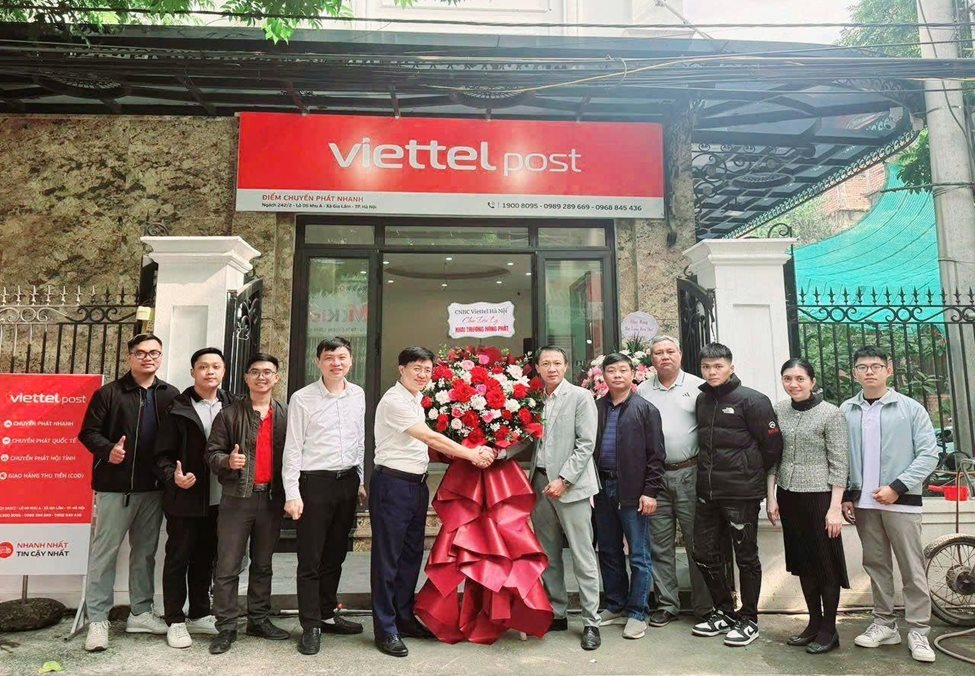
One of the authorized agencies launched in Hanoi last November
Structurally, logistics infrastructure consists of two layers.
The first layer is foundational, known as the trunk layer, operating at regional and national levels. The second layer comprises branches, such as post offices serving as the final customer touchpoints, and transportation means like motorcycles and small trucks delivering goods to individual homes.
A critical component is digital logistics infrastructure, which we refer to as smart lockers. These are automated pickup points that operate without human intervention. Our goal is to equip all residential complexes, buildings, and homes with smart locker systems, thereby establishing a comprehensive digital logistics network.
With this model, how will Viettel Post and the “entire nation” collaborate?
In logistics, both the trunk and branch layers are equally vital. Having a trunk network and warehouses without branch connections means customers won’t receive their goods. As a major enterprise, we focus on developing the trunk layer, including core technologies, large hubs, and extensive operational zones. The branch layer will be socialized.
What does this mean? If you live in an apartment complex and see the value in installing a smart locker, you can invest 70-100 million VND in one. This locker will integrate into Viettel Post’s logistics network.

Up to 80% revenue sharing for investors managing their own smartbox costs, with Viettel Post handling operations
Beyond smart lockers, if you invest in a small truck or minivan priced at 300-400 million VND, it can join Viettel Post’s network as a delivery vehicle. Alternatively, if you own land and wish
MOBILIZING THE ENTIRE NATION TO PARTICIPATE IN BUILDING THE NATIONAL LOGISTICS INFRASTRUCTURE
Recently, Viettel Post has made numerous new moves, which you refer to as the logistics infrastructure socialization strategy. What does this mean in simple terms?
Mr. Phung Van Cuong: In our view, logistics infrastructure socialization is simply mobilizing the entire population and society to participate in building the national logistics infrastructure.
Previously, infrastructure for energy, telecommunications, and even digital infrastructure was primarily developed by the state, large organizations, and units, without much involvement from the general public. However, we believe that the national logistics infrastructure can be built differently.
To better explain this perspective, we must first understand what logistics is. According to our redefined concept, logistics essentially ensures the flow of physical goods in society. Wherever there is a flow of goods, there is logistics. Thus, logistics reaches every individual and household, serving as the lifeblood of the economy.
One of the authorized agencies operated in Hanoi last November
Structurally, logistics infrastructure consists of two layers.
The first layer is foundational, known as the trunk layer, operating at the regional and national levels. The second layer comprises branches, such as post offices serving as the final customer touchpoints, and transportation means like motorcycles and small trucks delivering goods to individual homes.
Additionally, there is digital logistics infrastructure, which we refer to as smart lockers—automated delivery points that do not require human intervention. Our goal is to equip all residential buildings, offices, and homes with these smart systems, thereby establishing a comprehensive digital logistics network.
With this model, how will Viettel Post and the “general public” collaborate?
In logistics, both the trunk and branch infrastructure layers are equally critical. Having a trunk network and warehouses without branch connections means customers cannot receive their goods. As a major enterprise, we focus on developing the trunk infrastructure—core technologies, large hubs, and extensive operational zones. The branch infrastructure will be socialized.
What does this mean? If you live in an apartment complex and see the value in installing a smart locker, you can invest 70–100 million VND in one. This locker will be integrated into Viettel Post’s logistics network.
Up to 80% revenue sharing when investors self-fund, with Viettel Post operating the smartbox
Beyond smart lockers, if you invest in a small truck or minivan for 300–400 million VND, it can also be connected to Viettel Post’s network as a freight vehicle. Similarly, if you own land and wish to convert it into a warehouse or post office for handling goods, it can be integrated as a service point within Viettel Post’s network, with revenue shared between both parties.
This platform model resembles Grab or Uber but focuses on connecting logistics components rather than transporting people. This is how the general public can participate in building the branch infrastructure.
Internationally, this model is known as franchising, but its essence is socialization. We encourage other companies to adopt this model, as no single entity can accomplish everything alone.
DEAD TIME AND THE NON-STOP ECONOMY
What is the biggest bottleneck in Vietnam’s logistics today, and can the digital infrastructure you mentioned resolve it?
One of Vietnam’s primary logistics bottlenecks is excessive “dead time.” Currently, delivery personnel must visit post offices to collect items, then deliver them based on customer addresses.
Our analysis reveals that the most time-consuming aspect of the logistics supply chain is waiting. Before reaching customers, delivery personnel often call to confirm availability and delivery times. Nearly 100% of deliveries involve waiting, sometimes for over an hour.

In China, the global leader in logistics, the focus is on a non-stop logistics-driven economy, eliminating all wait times. Achieving this requires synchronized infrastructure.
Chinese delivery personnel handle 1,000–1,500 orders daily, compared to 70–80 in Vietnam—a 20-fold difference. In China, couriers can deliver hundreds of packages to a single building without individual calls, thanks to smart lockers. They complete deliveries within 15 minutes.
If successful, will digital logistics infrastructure revolutionize Vietnam’s current delivery system?
Absolutely. Traditionally, deliveries required face-to-face interactions, limiting accessibility by time, location, and availability.
We embrace the “3 Any” philosophy, inspired by telecommunications: Anyone can use it, Anytime, and Anywhere. Smart lockers in residential buildings allow customers to collect packages at 2 a.m. or while abroad, eliminating cancellations or rescheduling.
Initially, we offer free locker usage for the first 24 hours, with fees applying thereafter.
After one year, what are Viettel Post’s results?
We are focusing on major cities like Hanoi and Ho Chi Minh City, with expansion to select provinces. Previously, it took us 28 years to establish 1,500 post offices. With socialization, we added 700 post offices in just one year—an unprecedented rate.
Bac Ninh province stands out. Even after merging with Bac Giang, its leadership eagerly partnered with Viettel Post.
Initially, all government offices and state buildings will adopt smart lockers. Next are industrial zones, where workers on 8–10-hour shifts benefit from convenient package delivery without leaving their workplaces.
THE PAIN OF VIETNAM’S LOGISTICS SECTOR AND THE ASPIRATION FOR UNIVERSAL DIGITAL LOGISTICS
Foreign companies dominate Vietnam’s logistics market. Can Viettel Post’s efforts shift this balance?
We anticipate that our socialization strategy will transform the logistics landscape within 1–2 years. The entity with the most extensive network will prevail.
Currently, Vietnam’s logistics sector faces significant challenges. Foreign companies operate professionally with substantial capital, particularly e-commerce platforms and their affiliated logistics providers. This capital-intensive competition for market share is fierce. Once dominant, these companies significantly raise prices.
Vietnamese firms, with limited capital, cannot sustain such competition.
Socialization changes this dynamic. Local participation accelerates network expansion far beyond foreign companies’ capabilities. Additionally, leveraging local resources reduces costs compared to training external workforces.
Most importantly, local personnel understand regional nuances, enhancing service effectiveness. Socialization harnesses the power of Vietnam’s 100 million citizens.
Last
MOBILIZING THE ENTIRE NATION TO PARTICIPATE IN BUILDING THE NATIONAL LOGISTICS INFRASTRUCTURE
Recently, Viettel Post has made numerous new moves, which you refer to as the logistics infrastructure socialization strategy. What does this mean in simple terms?
Mr. Phung Van Cuong: In our view, logistics infrastructure socialization simply means mobilizing the entire population and society to participate in building the national logistics infrastructure.
Previously, infrastructure projects in energy, telecommunications, and even digital infrastructure were primarily undertaken by the government and large organizations, with little involvement from the general public. However, we believe that the national logistics infrastructure can be developed differently.
To better explain this perspective, we must first understand what logistics is. According to our definition, logistics essentially ensures the flow of physical goods within society. Wherever there is a flow of goods, logistics is present. Thus, logistics reaches every individual and household, serving as the lifeblood of the economy.
One of the authorized agencies operated in Hanoi last November
Structurally, logistics infrastructure consists of two layers.
The first is a foundational layer, known as the trunk layer, operating at the regional and national levels. The second layer comprises branches, such as post offices serving as the final customer touchpoints, and transportation means like motorcycles and small trucks delivering goods to individual homes.
Additionally, there is digital logistics infrastructure, which we refer to as smart lockers—automated delivery points that do not require human intervention. Our goal is to equip all residential buildings, offices, and homes with these smart systems, thereby establishing a comprehensive digital logistics network.
With this model, how will Viettel Post and the “entire nation” collaborate?
In logistics, both the trunk and branch layers are equally vital. Having a trunk network and warehouses without branch connections means customers cannot receive their goods. As a major enterprise, we focus on developing the trunk layer—core technologies, large hubs, and extensive operational zones. The branch layer will be socialized.
What does this mean? If you live in an apartment complex and see the value in installing a smart locker, you can invest 70-100 million VND in one. This locker will be integrated into Viettel Post’s logistics network.
Up to 80% revenue sharing when investors self-fund, with Viettel Post operating the smartbox
Beyond smart lockers, if you invest in a small truck or minivan for 300-400 million VND, it can also join Viettel Post’s network as a delivery vehicle. Similarly, if you own land and wish to convert it into a warehouse or post office, it can become a service point within Viettel Post’s network, with revenue shared between both parties.
This platform model resembles Grab or Uber but focuses on connecting logistics components rather than transporting people. This is how the entire nation can participate in building the branch infrastructure.
Internationally, this model is known as franchising, but its essence is socialization. We encourage other companies to adopt this approach, as no single entity can accomplish everything alone.
DEAD TIME AND THE NON-STOP ECONOMY
What is the biggest bottleneck in Vietnam’s logistics today, and can the digital infrastructure you mentioned resolve it?
One of Vietnam’s primary logistics bottlenecks is excessive “dead time.” Currently, delivery personnel must visit post offices to collect items, then deliver them based on customer addresses.
Our analysis reveals that the most time-consuming aspect of the logistics chain is waiting. Before reaching customers, delivery agents must call to confirm their availability and location. Upon arrival, they often wait—sometimes for hours—for customers to collect their packages.
In China, a global logistics leader, the focus is on a non-stop logistics economy, eliminating all wait times. Achieving this requires synchronized infrastructure.
Chinese delivery agents handle 1,000 to 1,500 orders daily, compared to 70-80 in Vietnam—a 20-fold difference. In China, agents can deliver hundreds of packages to a single building without individual customer calls, thanks to smart lockers. They complete deliveries within 15 minutes.
If successful, will digital logistics infrastructure revolutionize Vietnam’s current delivery model?
Absolutely. Traditionally, deliveries required face-to-face interactions, limiting accessibility by time, location, and availability.
We embrace a “3 Any” philosophy, inspired by telecommunications: Anyone can use it, Anytime, and Anywhere. Smart
MOBILIZING THE ENTIRE NATION TO PARTICIPATE IN BUILDING NATIONAL LOGISTICS INFRASTRUCTURE
Recently, Viettel Post has made numerous new moves, which you refer to as the logistics infrastructure socialization strategy. What does this mean in simple terms?
Mr. Phung Van Cuong: In our view, logistics infrastructure socialization simply means mobilizing the entire nation and society to participate in building the national logistics infrastructure.
Previously, infrastructure for energy, telecommunications, and even digital infrastructure was primarily developed by the state, large organizations, and units, without much involvement from the general public. However, we believe that national logistics infrastructure can be built differently.
To explain this perspective further, we must first understand what logistics is. According to our redefined concept, logistics essentially ensures the flow of physical goods in society. Wherever there is a flow of goods, there is logistics. Thus, logistics reaches every individual and household, serving as the lifeblood of the economy.
One of the authorized agencies operated in Hanoi last November
Structurally, logistics infrastructure consists of two layers.
The first is a foundational layer, known as the trunk layer, operating at the regional and national levels. The second layer comprises branches, such as post offices serving as the final customer touchpoints, and small transport vehicles like motorcycles and vans delivering goods to individual homes.
A
MOBILIZING THE ENTIRE NATION TO PARTICIPATE IN BUILDING THE NATIONAL LOGISTICS INFRASTRUCTURE
Recently, Viettel Post has made numerous new moves, which you refer to as the logistics infrastructure socialization strategy. What does this mean in simple terms?
Mr. Phung Van Cuong: In our view, logistics infrastructure socialization simply means mobilizing the entire population and society to participate in building the national logistics infrastructure.
Previously, infrastructure projects like energy, telecommunications, and even digital infrastructure were primarily undertaken by the government and large organizations, with little involvement from the general public. However, we believe that building the national logistics infrastructure can be approached differently.
To better explain this perspective, we must first understand what logistics is. According to our redefined concept, logistics essentially ensures the flow of physical goods within society. Wherever there is a flow of goods, logistics is present. Thus, logistics reaches every individual and household, serving as the lifeblood of the economy.
One of the authorized agencies operated in Hanoi last November
Structurally, logistics infrastructure consists of two layers.
The first is a foundational layer, referred to as the trunk layer, operating at the regional and national levels. The second layer comprises branches, such as post offices serving as the final customer touchpoints, and transportation vehicles like motorcycles and small trucks delivering goods to individual homes.
Additionally, there is the digital logistics infrastructure, which includes smart lockers—automated delivery points that do not require human intervention. Our goal is to equip all residential buildings, apartments, and homes with these smart systems, thereby establishing a comprehensive digital logistics network.
With this model, how will Viettel Post and the “entire nation” collaborate?
In logistics, both the trunk and branch infrastructure layers are equally vital. Having a trunk network and warehouses without branch connections means customers cannot receive their goods. As a major enterprise, we focus on developing the trunk infrastructure—core technologies, large hubs, and extensive operational zones. The branch layer, however, will be socialized.
What does this mean? If you live in an apartment complex and see the value in installing a smart locker, you can invest 70-100 million VND to set one up. This locker will be integrated into Viettel Post’s logistics network.
Up to 80% revenue sharing for investors managing their own smartbox costs, with Viettel Post handling operations
Beyond smart lockers, if you invest in a small delivery van costing 300-400 million VND, it can also be connected to the Viettel Post network. Similarly, if you own a plot of land and wish to convert it into a warehouse or post office for handling goods, it can be integrated as a service point within the Viettel Post network, with revenue shared between both parties.
This platform model resembles that of Grab or Uber but focuses on connecting logistics components rather than transporting people. This is how the entire nation can participate in building the branch infrastructure layer.
Internationally, this model is known as franchising, but its essence is socialization. We encourage other companies to adopt this model, as no single entity can accomplish everything alone.
DEAD TIME AND THE NON-STOP ECONOMY
What is the biggest bottleneck in Vietnam’s logistics sector today, and can the digital infrastructure you mentioned resolve it?
One of the most significant bottlenecks in Vietnam’s logistics is the excessive “dead time.” Currently, delivery personnel must visit post offices to collect items, then follow a list to deliver them to customers’ addresses.
Our analysis shows that the most time-consuming aspect of the logistics supply chain is waiting. Before reaching a customer’s home, delivery staff often call to confirm availability and delivery times. Upon arrival, they frequently wait—sometimes for an hour or more—for customers to collect their packages.
In China, a global leader in logistics, the focus is on a non-stop logistics-driven economy, eliminating all wait times. Achieving this requires synchronized infrastructure.
On average, a Chinese delivery person handles 1,000 to 1,500 orders daily, compared to 70-80 orders in Vietnam. Their productivity is approximately 20 times higher. Chinese couriers can deliver hundreds of packages to a single building without individual customer calls, thanks to smart lockers. They complete deliveries within 15 minutes.
If successful, will digital logistics infrastructure revolutionize Vietnam’s current delivery system?
Absolutely. Traditionally, deliveries required face-to-face interactions, limiting accessibility in terms of who, when, and where services could be provided.
We adhere to the “3 Any” philosophy, inspired by telecommunications: Anyone can use the service, Anytime they need it, and Anywhere they are.
With smart lockers in residential buildings, customers can collect packages
Mobilizing the Entire Nation to Build a National Logistics Infrastructure
In recent times, Viettel Post has made numerous new moves, which you refer to as the socialization strategy of logistics infrastructure. What does this mean in simple terms?
Mr. Phung Van Cuong: In our view, the socialization of logistics infrastructure simply means mobilizing the entire population and society to participate in building the national logistics infrastructure.
Previously, infrastructure projects in energy, telecommunications, and even digital infrastructure were primarily undertaken by the government, large organizations, and major entities, with little involvement from the general public. However, we believe that the national logistics infrastructure can be developed differently.
To better explain this perspective, it’s essential to understand what logistics is. According to our redefined concept, logistics is essentially the activity that ensures the flow of physical goods within society. Wherever there is a flow of goods, logistics is present. Thus, logistics reaches every individual and household, serving as the lifeblood of the economy.
One of the authorized agencies launched in Hanoi last November
Structurally, logistics infrastructure consists of two layers.
The first layer is foundational, known as the trunk layer, operating at the regional and national levels. The second layer comprises the branch components, such as post offices, which serve as the final points for customer service, and transportation means like motorcycles and small trucks that deliver goods directly to homes.
Notably, there is also the digital logistics infrastructure, which we refer to as smart lockers. These are intelligent delivery points that operate without human intervention. Our goal is to equip all residential complexes, buildings, and homes with these smart locker systems, thereby establishing a comprehensive digital logistics infrastructure.
With this model, how will Viettel Post and the “general public” collaborate?
In logistics, both the trunk and branch layers of infrastructure are equally crucial. Having a trunk network and warehouses without branch connections means customers cannot receive their goods. As a major enterprise, we focus on developing the trunk layer, which includes core technologies, major platforms, large centers, and key operational zones. The branch layer, however, will be socialized.
What does this mean? If you live in an apartment complex and see the need for a smart locker, you can invest between 70 to 100 million VND to install one. This locker will be integrated into Viettel Post’s logistics network.
Revenue sharing up to 80% when investors cover costs, with Viettel Post operating the smartbox
Not limited to smart lockers, if you invest in a small truck or minivan priced at 300-400 million VND, it can also be connected to Viettel Post’s network to become a freight vehicle. Alternatively, if you own a plot of land and wish to convert it into a warehouse or post office for handling goods, it can be integrated as a service point within Viettel Post’s network, with revenue shared between both parties.
This platform model is similar to Grab or Uber, but instead of transporting people, we are building a platform that connects various components of the logistics industry. This is how the general public can participate in developing the branch infrastructure layer.
Abroad, this model is known as franchising, but its essence is socialization. We hope other companies will adopt this model, as no single entity can accomplish everything alone.
DEAD TIME AND THE NON-STOP ECONOMY
What is the biggest bottleneck in Vietnam’s logistics sector today, and can the digital infrastructure you mentioned resolve this issue?
One of the most significant bottlenecks in Vietnam’s logistics sector is the excessive “dead time.” The current model requires delivery personnel to visit post offices to collect packages. They then deliver these packages based on customer addresses and lists.
Our analysis shows that the most time-consuming aspect of the logistics supply chain is waiting. Before reaching a customer’s home, delivery personnel must call to confirm if the customer is available and at what time. Upon arrival, they often have to wait, sometimes for an hour or more, for nearly every delivery.
In China, the global leader in logistics, they speak of a non-stop economy powered by logistics—one without any waiting. Achieving this requires synchronized infrastructure.
On average, a Chinese delivery person handles 1,000 to 1,500 orders per day, compared to 70-80 orders per day in Vietnam. Their productivity is about 20 times higher. Chinese delivery personnel can bring hundreds of packages to a single building without needing to call each recipient, thanks to smart lockers installed in the building. They can deposit hundreds of packages into these lockers within just 15 minutes.
It seems that if successful, digital logistics infrastructure will revolutionize the entire delivery process in Vietnam?
Absolutely. Traditionally, delivering goods required a face-to-face meeting. However, this method is not always feasible, as not everyone can use it, and it is not available at all times or locations.
We adhere to a philosophy called “3 Any,” inspired by the telecommunications sector: Anyone can use it, Anytime it’s needed, and Anywhere it’s required.
With smart lockers in residential complexes, customers can collect their packages at 2 a.m. if needed. Even if you’re abroad, you can still receive your goods without canceling or rescheduling deliveries. Such innovations help reduce congestion and optimize the flow of logistics.
Initially, we offer free locker usage for the first 24 hours, with fees applying thereafter.
After one year of implementation, what results has Viettel Post achieved?
We are focusing on major cities like Hanoi and Ho Chi Minh City for pilot projects and have begun expanding to other provinces. Previously, it took us 28 years to establish 1,500 post offices independently. However, with the socialization model, we have opened 700 post offices in just one year—an astonishing rate.
During our expansion, Bac Ninh province stood out. Even after merging with Bac Giang, the provincial leadership showed great enthusiasm and proposed collaboration with Viettel Post.
Initially, all government offices and state-owned buildings will deploy smart lockers. Next, we will target industrial zones, where many workers are employed for 8 to 10 hours without breaks but have a high demand for delivery services.
THE PAIN POINTS OF VIETNAM
Geleximco Faces Challenges in Four Major Projects in Da Nang

Geleximco Group has announced the progress of four major projects in Da Nang, showcasing their commitment to significant developments in the region.
Unlocking Vietnam’s Maritime Potential: MSC CEO Advocates for Larger Vessels in Vietnamese Ports

MSC, the world’s leading container shipping company, faces challenges beyond mere water depth in Vietnam’s ports. The true hurdles lie in the design, connectivity, and operation of the entire port and logistics ecosystem, which currently fall short of MSC’s expectations, limiting the number of ports capable of accommodating their vessels.
Mobilizing Full Force at Lien Chieu Port Project to Meet Deadline Before Tet Binh Ngo 2026
The Lien Chieu Port project has now achieved 95% of its total volume value and is expected to be completed before the Year of the Horse.
Why Dong Hai is Emerging as Hai Phong’s New Central Business District (CBD)?

Dong Hai, formerly known as Hai An District, is emerging as the new Central Business District (CBD) not only for Hai Phong but for the entire Northern region of Vietnam. Its unparalleled infrastructure, including an airport, seaport, railway, industrial zones, and a free trade area, sets it apart as a uniquely connected hub unmatched by any other area in the North.
ADB Country Director Highlights Vietnam’s Remarkable Progress Over the Past Decade

On the morning of November 25th, in Hanoi, the Ministry of Finance and the Asian Development Bank (ADB) jointly hosted the 2025 High-Level Public-Private Partnership (PPP) Dialogue. This pivotal event brought together regulatory bodies, development partners, and domestic and international investors. It took place as Vietnam finalizes significant amendments to its PPP Law, marking a critical phase in the nation’s development trajectory.