From the “Heart” of the Refinery to the Catalyst Equation
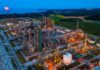
In the operational process of the Dung Quat Oil Refinery, the RFCC unit (Residue Fluid Catalytic Cracking) is often referred to as the “heart” of the entire system. This is where the transformation of heavy residue from crude oil distillation (CDU) into high-value light products such as gasoline, LPG, propylene, diesel, and fuel oil takes place.
The RFCC complex consists of four units: the reaction tower, catalyst regeneration system, product separation, and gas processing. With a design capacity of approximately 69,700 barrels per day, the RFCC can operate at over 110% capacity under optimal conditions, showcasing the technical expertise, operational efficiency, and continuous innovation of BSR’s engineering team.
At the core of the RFCC process is the catalyst—a critical factor determining the efficiency and quality of the final products. The catalyst used is a fine zeolite powder with an average size of 70 microns, operating in a “fluidized bed” state to facilitate the breaking down of long-chain molecules in heavy feedstock. The system maintains a balance of 600–650 tons of catalyst, with 8–13 tons of fresh catalyst added daily.
Simultaneously, the amount of spent catalyst discharged is nearly equivalent to the fresh catalyst added, averaging 10 tons per day. This spent catalyst is collected at designated locations such as Hopper D-1506 and Silo Fine, then classified and treated according to the national standard QCVN 07:2009/BTNMT for hazardous waste. Since the refinery’s inception, samples of spent RFCC catalyst have been sent to certified laboratories for analysis, consistently meeting requirements and falling below hazardous waste thresholds.
However, on March 21, 2023, a laboratory reported arsenic (As) levels in a catalyst batch from February 24, 2023, at 8.05 mg/L, exceeding the standard limit of 2 mg/L. If confirmed, this batch would be classified as hazardous waste, significantly increasing disposal costs from 736,000 VND/ton to 4.6 million VND/ton.
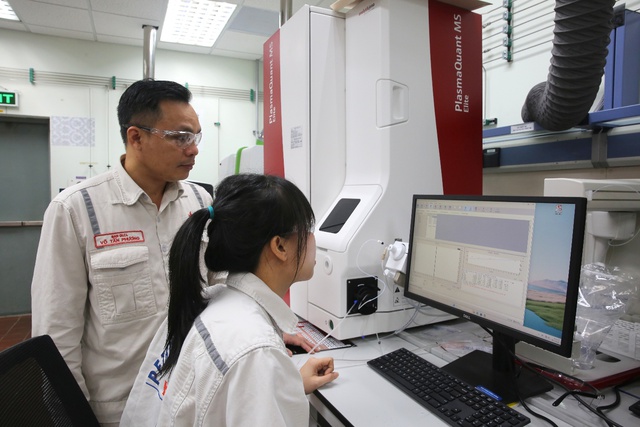
Faced with this anomaly, BSR’s Laboratory Division, led by Engineer Vo Tan Phuong, took on the task of reanalyzing all raw materials, chemicals, and additives used in the RFCC unit to trace the source of arsenic accumulation. The results indicated no significant arsenic sources capable of causing such high levels, suggesting potential interference in the external laboratory’s testing method.
When BSR Engineers Diagnose and Innovate
In response, BSR’s Laboratory Division embarked on developing an in-house analytical method to replace external services. This required not only advanced knowledge in chemical analysis but also a deep understanding of the RFCC process.
Initially, BSR’s laboratory was not equipped to analyze trace metals like arsenic and antimony in catalysts. However, the team leveraged existing equipment, particularly the ICP-OES spectrometer and rotary evaporator, to establish a metal extraction process based on EPA 200.7 and 1311 standards, adapted to local conditions.
This innovative approach replaced costly specialized equipment with the rotary evaporator, effectively extracting metals into an aqueous phase. The team identified lanthanum (La), a rare earth element present in zeolite catalysts, as the primary source of interference causing arsenic overestimation. Through rigorous experimentation, they developed a solution to mitigate this interference, ensuring accurate analysis at 193nm and 197nm wavelengths on the ICP-OES.
The initiative saves BSR approximately 1.033 billion VND annually
This homegrown solution not only enhanced analytical accuracy but also met ISO 17025 technical requirements. Reanalysis using the new method confirmed that arsenic levels in RFCC catalysts were within safe limits, below hazardous waste thresholds. The team collaborated with external laboratories to retest the February 24, 2023 batch, which subsequently met regulatory standards.
The innovation, titled “Improving Arsenic and Antimony Analysis Methods (EPA 200.7 & 1311) in RFCC Catalysts for Enhanced Accuracy,” won first prize at the 14th Quang Ngai Provincial Technical Innovation Competition (2024–2025). Technically and environmentally, the new method enables BSR’s laboratory to fully control catalyst quality, optimize Ni passivator usage, and accurately classify spent catalysts according to QCVN 07:2009/BTNMT, ensuring compliance and cost efficiency.
Economically, the benefits are substantial. Previously, BSR sent approximately 208 spent catalyst samples annually for external testing at an average cost of 5.28 million VND per sample. With in-house testing, the cost is reduced to 313,033 VND per sample, saving BSR approximately 1.033 billion VND annually, excluding indirect benefits from faster quality control and process adjustments.
Mr. Pham Cong Nguyen, Head of BSR’s Safety and Quality Division, remarked, “This initiative is more than a technical solution; it embodies BSR’s culture of innovation, proactiveness, and scientific rigor. From identifying anomalies to diagnosing, analyzing, and developing a complete alternative method, BSR’s engineers demonstrated mastery of technology and boundless creativity. They not only solved a specific technical issue but also reduced costs, enhanced sustainability, and exemplified BSR’s ethos: think deeply, act decisively, and deliver high-impact results.”
Through ingenuity and dedication, BSR’s laboratory engineers transformed a seemingly minor task into a solution saving over 1 billion VND annually. This story underscores that at Dung Quat Oil Refinery, every innovation, whether in the laboratory or production, contributes significantly to the company’s value and Vietnam’s energy and petrochemical industry.
Transform Your Gasoline Motorcycle to Electric for Just $350?

Motorcycles TV believes that converting gasoline-powered motorcycles to electric engines offers significant economic benefits.
Pioneering MPL Pilot Training: BAA Training Vietnam and Bamboo Airways Lead the Way
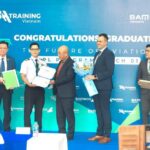
On the morning of September 16, 2025, BAA Training Vietnam and Bamboo Airways jointly hosted a graduation ceremony at the BAA Training Vietnam Pilot Training Center in Thu Duc City, Ho Chi Minh City, for MPL (Multi-Crew Pilot Licence) trainees in Vietnam.