In the latest update, SGI Capital reports that liquidity on the Vietnamese stock market (VN Stock) has yet to improve, but foreign net selling pressure has eased. Additionally, a decrease in margin ratios has reduced supply-side pressure on the overall market.
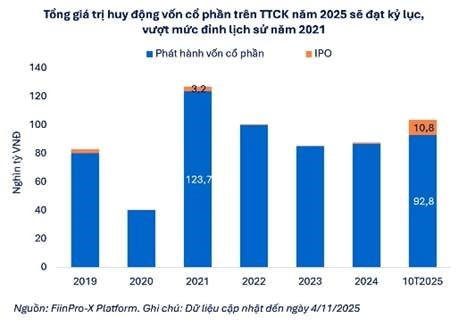
However, financial market pressures persist due to year-end bond redemptions and high levels of share issuance and IPOs, which are expected to surpass 2021 figures and set a new historical record for VN Stock. Moreover, the market is not yet undervalued, given rising interest rates, which have constrained demand and made a short-term rally unlikely.
SGI Capital anticipates that over the next three months, there is potential for credit room expansion in 2026, which could create a typical early-year market upswing. This, according to SGI, depends largely on the pace of systemic liquidity improvement based on capital mobilization in the coming months.
If mobilization is successful, interest rates may stabilize, enabling capital to flow into investment opportunities. Conversely, if credit growth outpaces mobilization capacity, interest rates will continue to rise, leading to inter-market capital competition. This would further reduce VN Stock liquidity, forcing investors and businesses to sell securities to manage debt and liquidity shortfalls.
Drawing on past rate hike cycles, businesses and investors should not underestimate the possibility of prolonged rate increases and tighter liquidity in 2026, which could dampen trading activity in both stock and real estate markets.
“Significant opportunities for value investors may arise in the coming months as speculative capital, fueled by cheap debt, exits the market under rising rate pressures, potentially creating attractive valuation levels,” the report highlights.
However, SGI also cautions that this is a highly sensitive period for both the financial market and VN Stock in particular.
Notable Macro Signals: Policy Limits and Interest Rate Cycles
For Vietnam, SGI Capital notes emerging macro signals regarding policy constraints and interest rate cycles. According to the Ministry of Finance, achieving 10% GDP growth requires approximately $1.4 trillion in investment over the next five years ($280 billion annually), with over $250 billion needing to come from domestic sources. As bank credit capacity nears its limit, attracting long-term foreign capital is critical to easing rate pressures and stabilizing exchange rates.
Bank liquidity is under strain, with overnight interbank rates exceeding 7%—the highest since October 2022—and OMO rates rising from 4% to 4.5%, indicating a shift away from monetary easing.

In November, banks aggressively raised deposit rates to address liquidity shortfalls. Persistent under-mobilization relative to lending (2022–2025) has strained the system, with many banks exceeding a 100% net LDR (loan-to-deposit ratio), relying heavily on short-term OMO and interbank funding.
Upcoming public investment disbursements and real estate projects will require substantial long-term capital, further pressuring LDR. If credit limits are expanded next year, economic leverage could rise, exacerbating the mismatch between short-term capital and long-term investment needs—a concern flagged by Fitch Ratings in early December.
SGI emphasizes that Vietnam’s economic cycle is closely tied to its credit cycle due to heavy reliance on the banking system. In the previous cycle, credit reached 115% of GDP, with system-wide LDR hitting 115%, forex reserves falling below two months of imports, and 30–40% annual credit growth in 2009–2010 causing liquidity shortages, real estate bubbles, inflation spikes, and a subsequent market freeze.
By late 2025, SGI estimates credit could reach 145% of GDP, with LDR nearing 115% and forex reserves again below two months of imports.
Notably, short-term liquidity support—treasury funds, OMO, and SBV facilities—has been extensively utilized, with OMO balances at a record high of over VND 350 trillion. Banks, struggling to mobilize deposits, have increased interbank borrowing to 15% of total assets.
Given this scale of support, interbank rates consistently above 7% in recent weeks indicate systemic liquidity shortages, not just seasonal or isolated issues.
Earning $1.5 Billion in 6 Hours: Billionaire Pham Nhat Vuong Sets a New Record
The trading session on December 8th marked a historic milestone, not only for Chairman Pham Nhat Vuong’s remarkable asset growth but also for Vingroup, as it became the first Vietnamese enterprise to reach a market capitalization of 1.2 million billion VND.
FTSE Russell Index Drops Two Vietnamese Stocks from Portfolio

Conversely, no Vietnamese stocks were added to this index basket.
Gold Prices Plummet: SJC and Ring Gold Investors Face Potential $170 Loss per Tael in Just One Week
Investing in gold rings last weekend could result in a significant loss of up to 4 million VND per tael if sold today.
Gold Prices Plummet: SJC and Ring Gold Investors Face Potential $170 Loss per Tael in One Week
If you had purchased gold rings last weekend and sold them today, you could have incurred a loss of up to 4 million VND per tael.
Expert Insights: Early Stages of a New Wave in the Market – VN-Index May Fluctuate Before Targeting 1,800 Points

Early adjustments in the market, if they occur at the beginning of the week, are likely to stimulate low-price demand, thereby creating a more favorable environment for the VN-Index to gradually approach the target range of 1,800 points in the remainder of December.