




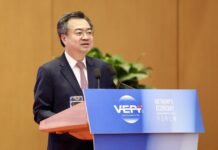












The Vietnam Economy in 2025 and Prospects in 2026 Forum (VEPF) convened in Hanoi on December 16, co-hosted by the Government and the Party Central Committee’s Commission for Policies and Strategies.
In his opening remarks, Mr. Nguyen Thanh Nghi, a member of the Party Central Committee and Chairman of the Commission for Policy and Strategy, emphasized VEPF’s significance as a pivotal annual event. It draws participation from policymakers, the business community, diplomatic missions, international organizations, and research institutes.
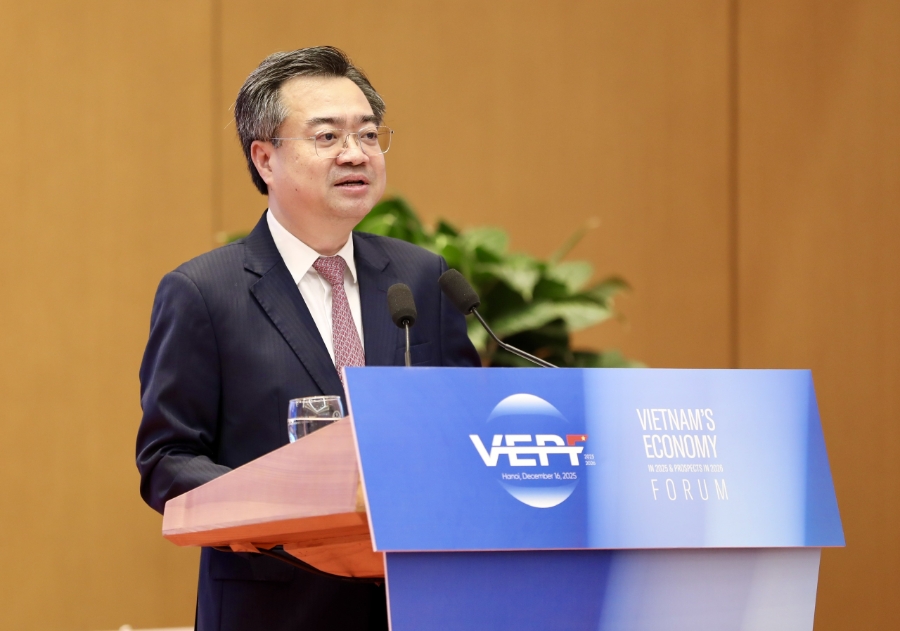
This year’s event attracted over 500 in-person delegates and more than 1,000 online participants from all 34 cities and provinces nationwide.
During the finance and banking session, discussions centered on securing financial resources and achieving economic growth targets for 2026–2030. Effective mobilization of financial resources was identified as critical for Vietnam to reach its goal of double-digit economic growth during this period.
Mr. Pham Thanh Ha, Deputy Governor of the State Bank of Vietnam, highlighted the Party and State’s target of achieving at least 8% economic growth in 2025, progressing toward double-digit growth by 2026–2030. This trajectory is essential for Vietnam to join the upper-middle-income group by 2030 and become a high-income nation by 2045.
Mr. Ha stressed that securing substantial capital resources and utilizing them efficiently to foster a science- and innovation-driven growth model are key challenges for high growth.
Deputy Minister of Finance Do Thanh Trung emphasized that while mobilizing capital is vital, allocating it to the right priorities and ensuring its effective use to generate high added value are paramount.
Dr. Can Van Luc, Chief Economist at BIDV and a member of the National Financial and Monetary Policy Advisory Council, presented a paper on innovative solutions to mobilize financial resources for high growth in 2026–2030. He advocated for a shift from a capital- and labor-intensive model to one driven by science, technology, innovation, and productivity.
Participants agreed that developing the capital market as the primary channel for medium- and long-term resource mobilization is essential to reduce pressure on the banking system. Strengthening fiscal and monetary policy coordination is crucial for macroeconomic stability, inflation control, and high growth amid rising risks. Additionally, improving the investment climate, institutional reforms, and a stable legal framework are key to attracting and retaining high-quality financial resources.
At the circular economy session, Mr. Pham Dai Duong, Deputy Head of the Party Central Committee’s Commission for Policies and Strategies, underscored the need for Vietnam to innovate its growth model to achieve strategic development goals. The new model must be sustainable, inclusive, and focused on quality, efficiency, and competitiveness. It should prioritize digital and green transformations, including building a digital economy, adapting to climate change, and meeting international commitments like net-zero emissions by 2050.
Mr. Duong emphasized that digital and green transitions are interconnected and essential for global growth. The circular economy, as a key driver of green transformation, is a strategic pillar of this new model.
Deputy Minister of Agriculture and Environment Le Cong Thanh noted Vietnam’s progress in establishing a framework for green and circular economy development. The merger of the Ministries of Agriculture and Rural Development and Natural Resources and Environment reflects an integrated management approach. However, challenges remain, including traditional practices, capital constraints, and unsynchronized emerging markets like carbon credits.
Ms. Francesca Nardini, Deputy Resident Representative of the United Nations Development Programme (UNDP) in Vietnam, stated that the circular economy could reduce urban waste by 30–34% and greenhouse gas emissions by 40–70% from 2030 to 2060, while creating jobs and reducing raw material imports. UNDP recommends pilot models to assess risks and benefits before scaling up.
Experts agreed that green transformation and the circular economy are vital for Vietnam’s high growth and sustainable development in the digital era.
A UNDP representative highlighted Vietnam’s potential to improve resource efficiency, reduce waste, and promote green industries. Better utilization of domestic waste, such as agricultural by-products and plastic waste, could significantly advance the circular economy.
A representative from the United Nations Industrial Development Organization (UNIDO) discussed support for transforming six eco-industrial parks in Hai Phong, Dong Nai, Da Nang, Tay Ninh, and Bac Ninh. The industrial symbiosis model shows promise, with companies using each other’s waste as inputs.
Mr. Ngo Minh Hai of TH Group highlighted the company’s focus on sustainable development, investing in green technologies and closed-loop dairy processing. TH has replaced fossil fuels with biomass boilers and expanded solar power use.
Mr. Hoang Manh Cam of the Vietnam National Textile and Garment Group noted the industry’s shift toward higher-value products and extended product life cycles due to weaker consumer demand. The company is upgrading machinery for cost savings.
Unlocking Vietnam’s Green Future: Where Will the $700 Billion in Green Capital Come From?

Deputy Governor of the State Bank of Vietnam, Nguyen Ngoc Canh, revealed that by 2050, the total long-term investment demand for green and sustainable economic development is projected to reach between $670 billion and $700 billion. This staggering figure underscores the urgent need to mobilize and strengthen all resources to achieve the nation’s green growth objectives.
Market Experts: Stocks Feel Like a Massive “Sale Off” – Already “Cheap” Shares Could Get Even Cheaper

Amidst a steep market downturn, liquidity on HoSE has remained stagnant at a moderate level of approximately VND 22 trillion, attributed to systemic liquidity shortages and mounting pressure from rising interest rates.
Deputy Governor: Green Credit Outstanding Reaches Approximately VND 750 Trillion

As of November 30, 2025, green credit outstanding debt reached approximately 750 trillion VND, with an average annual growth rate of 21% from 2017 to September 2025, surpassing the overall credit growth rate of the entire economy.
Green Credit Debt Reaches 750 Trillion VND, with Anticipated 2% Annual Interest Rate Support for Green Projects

The State Bank of Vietnam (SBV) is collaborating with the Ministry of Finance to propose a government decree offering a 2% annual interest rate subsidy from the state budget. This initiative aims to support private enterprises and business households borrowing from banks to implement green projects and circular economy initiatives.
Accelerating Public Investment Disbursement: Opportunities and Challenges
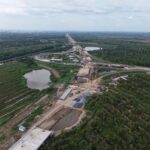
As of now, Ho Chi Minh City has achieved a public investment capital disbursement rate higher than the national average. However, it has yet to meet its targets and falls short of expectations.