


















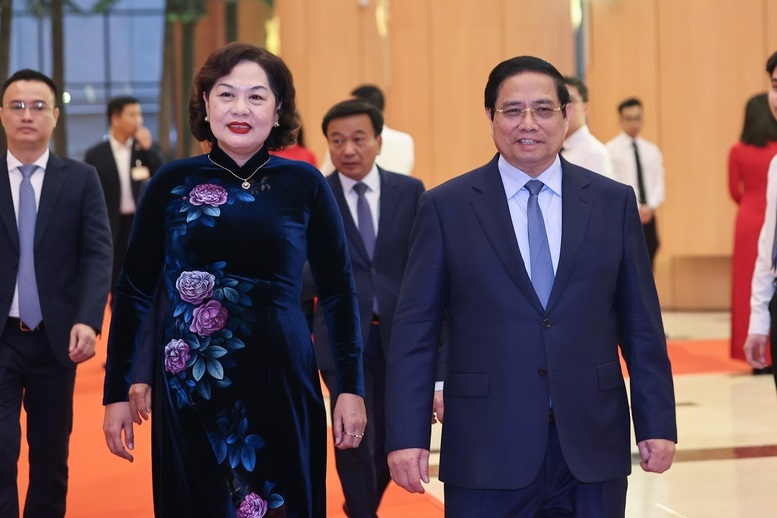
Prime Minister Pham Minh Chinh attended the 2025 Review Conference and the 2021-2025 term, implementing the banking sector’s tasks for 2026 – Photo: VGP/Nhat Bac
|
According to the State Bank of Vietnam (SBV), in 2025, adhering to the guidelines, resolutions of the Party, National Assembly, and Government, as well as the directives of the Prime Minister, the State Bank has proactively, flexibly, and effectively managed monetary policy. This has been coordinated harmoniously and closely with fiscal policies and other policies to prioritize and vigorously promote economic growth while maintaining macroeconomic stability and controlling inflation.
Governor of the SBV, Nguyen Thi Hong, assessed that the 2021-2025 term was a period of unprecedented turbulence, challenges, and difficulties. However, it was also a term marked by significant achievements, efforts, and emotions, with the banking sector largely accomplishing its set goals and tasks.
Monetary policy has been managed flexibly, actively supporting high economic growth, controlling inflation, and stabilizing the monetary and foreign exchange markets despite numerous pressures. Simultaneously, the banking sector has been actively implementing the restructuring of credit institutions. The SBV is among the leading ministries and sectors in digital transformation, administrative procedure reform, database development, and the creation of various utilities to serve businesses and citizens.
The SBV is one of the leading ministries in completing the early reorganization and streamlining of its organizational structure according to Resolution No. 18-NQ/TW. This was achieved through scientific methods, introducing a new organizational model and a seamless, efficient technology system from the beginning of March 2025.
Despite these achievements, Governor Hong emphasized that there are still many challenges and difficulties in the new phase, requiring the banking sector to actively innovate, enhance management capabilities, and adapt quickly to the new context.
8 Outstanding Achievements of the Banking Sector
Speaking at the Conference, on behalf of the Party and State leaders, Prime Minister Pham Minh Chinh acknowledged and commended the SBV and the banking sector for their significant and positive contributions to the country’s overall achievements in 2025 and the 2021-2025 term.
According to the Prime Minister, the situation over the past period has been rapidly changing and unpredictable, with many issues exceeding forecasts, impacting global development, including Vietnam. We consistently identify difficulties and challenges as greater than opportunities and advantages to prepare and respond, especially in flexibly managing policies and guiding the country’s development.
At the 9th Banking Sector Emulation Congress held on November 24, 2025, Prime Minister Pham Minh Chinh summarized the achievements and contributions of the banking sector in 32 words: “Open institutions, pioneering infrastructure, flexible policies, reasonable management, effective recovery, developing banks, benefiting people, and a self-reliant nation.” The Prime Minister further highlighted 8 outstanding achievements of the sector during this period.
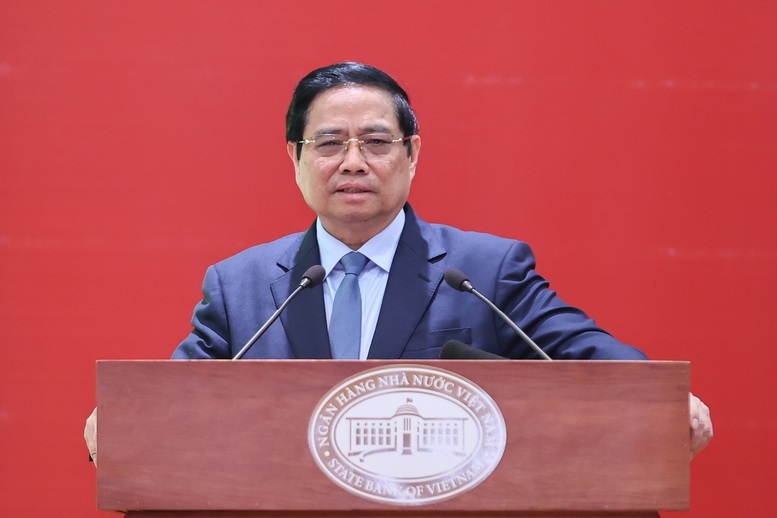
The Prime Minister emphasized and clarified the 8 outstanding achievements of the sector during this period – Photo: VGP/Nhat Bac
|
On “Open Institutions”, the SBV is one of the leading agencies in implementing strategic breakthroughs in perfecting institutions, mechanisms, policies, and legal regulations. It has completed and exceeded targets for reducing and simplifying administrative procedures: In 2025, it continued to reduce and simplify 90.3% of administrative procedures; cut 33.1% of business conditions; reduced 32.8% of days for processing administrative procedures and 31.5% of compliance costs (exceeding the 30% target). Notably, the SBV recently provided an additional 32 online public services on the National Public Service Portal.
On “Pioneering Infrastructure”, the banking sector continues to lead in developing banking infrastructure, especially in building databases, digital transformation, and non-cash payment systems. Non-cash payments in the 2021-2025 period are estimated to increase by about 70% in volume and 24% in value; in 2025, compared to GDP, it is estimated at over 27 times. Efforts have also been made to shorten processing times, improve service quality, and promote digital transformation across sectors and fields.
On “Flexible Policies”, the SBV has proactively, flexibly, and effectively managed monetary policy, maintaining key interest rates in the context of rising global interest rates to provide low-cost capital for credit institutions and support the economy. It has also required credit institutions to reduce costs and digitize to lower lending rates, implementing large-scale preferential credit packages (such as lending programs for agriculture, forestry, and fisheries; a VND 500 trillion credit program for infrastructure and digital technology with interest rates 1-1.5% lower than average; policy credit programs, and reduced lending rates for businesses affected by natural disasters and floods).
On “Reasonable Management”, the SBV has skillfully managed monetary policy tools, contributing to controlling inflation as targeted (averaging 3.29% in 11 months), maintaining macroeconomic stability, and promoting economic growth. The exchange rate and foreign exchange market have remained stable, ensuring the credit needs of the economy. As of December 24, 2025, outstanding credit was approximately VND 18.4 trillion, up 17.87% from the end of 2024, with an additional credit volume of about VND 2.79 trillion.
On “Effective Recovery”, the sector has focused on systematically and effectively handling weak banks, transferring 4 weak banks, ensuring the interests of depositors, and achieving positive changes. Efforts have also been made to enhance security, reduce fraud, and proactively prevent risks through digital identification and financial infrastructure. As of December 19, 2025, biometric verification has been conducted for over 142.5 million individual customer records and over 1.5 million organizational records; the number of individual customers scammed has decreased by 57%, and scam-receiving accounts have dropped by 47%.
On “Developing Banks”, the restructuring and efficiency enhancement of operations, coupled with bad debt handling, have made significant progress. Bad debts have been controlled (with non-performing loans below 2%), and the financial capacity, business efficiency, and competitiveness of credit institutions have improved. By the end of September 2025, the total assets of the system reached over VND 25.8 trillion, up 84.4% from 2020; chartered capital reached over VND 1.2 trillion, up 82.4%; and equity reached over VND 1.58 trillion, up 52.7%.
On “Benefiting People”, through the banking sector’s innovations, people have gained broader access to higher-quality financial services. The proportion of adults with bank accounts reached 87% (compared to 68.4% in 2020), with a significant increase in digital transactions via the internet and e-wallets. The stable payment system has enabled faster, more convenient, and safer transactions (through biometrics and digital identification). The sector has also actively contributed to social welfare, supporting COVID-19 prevention efforts with nearly VND 4.2 trillion, donating over VND 1.8 trillion for temporary housing elimination, and providing over VND 3.5 trillion for housing construction and gifts during holidays and festivals.
On “A Self-Reliant Nation”, the SBV and the banking sector’s successful task completion has contributed to the country’s development, helping the Vietnamese economy overcome challenges, promote high economic growth, maintain macroeconomic stability, control inflation, and ensure major balances.
Alongside these achievements, the Prime Minister agreed with the conference’s identified limitations, shortcomings, and difficulties, such as businesses still facing challenges in accessing capital, especially small and medium-sized enterprises; risks related to technology, markets, and bank investments; difficulties in exchange rates and the gold market; some weak credit institutions; and potential risks in certain credit sectors. Rapid digital transformation faces many challenges, especially high-tech crimes and electronic payments; there is a shortage of high-quality human resources, particularly in information technology. Monetary policy management pressures are increasing, especially regarding inflation, exchange rates, and interest rates, amid external pressures. Early warning systems remain limited.
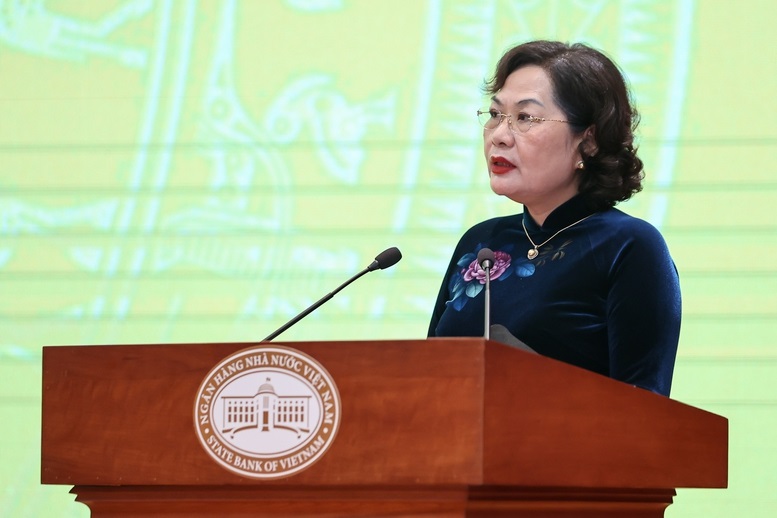 Governor of the SBV, Nguyen Thi Hong, speaks at the conference – Photo: VGP/Nhat Bac
|
Policy changes and status transitions must have appropriate steps, roadmaps, and solutions
After analyzing objective and subjective causes, the Prime Minister emphasized several lessons: It is crucial to remain calm and steadfast in the face of unpredictable changes and challenges; policy changes and status transitions must have appropriate steps, roadmaps, and solutions. Taking off requires breakthroughs and acceleration to soar high, while landing must be smooth, flexible, skillful, and safe. Policy management must be proactive, flexible, timely, suitable, effective, and coordinated with other policies.
The year 2026 is significant, marking the 14th Party Congress and the first year of implementing the Congress’s resolutions and the 2026-2030 Five-Year Plan. The Prime Minister emphasized that the banking sector must contribute to controlling inflation, stabilizing the macroeconomy, promoting double-digit growth, ensuring major economic balances, and improving people’s material and spiritual lives, aiming to achieve the 100-year strategic goals.
The SBV must focus on proactive, flexible, timely, and effective policy management, closely coordinating with other policies to create synergistic effects. It requires higher determination, greater efforts, more decisive actions, and improved efficiency, with a focus on clear assignments: clear responsibilities, tasks, timelines, authorities, and results.
The Prime Minister generally agreed with the banking sector’s key tasks and solutions for 2026, as outlined in the SBV’s report and delegates’ opinions, emphasizing 8 key areas.
These include implementing the 14th Party Congress resolutions, conclusions of the Politburo, Secretariat, National Assembly, Government, and the Prime Minister’s directives. Creating stronger institutional and administrative reforms in the monetary and banking sectors to meet the country’s development needs. Effectively managing banking activities in international financial centers in Ho Chi Minh City and Da Nang, especially in foreign exchange and cross-border capital flows.
All banking activities must innovate and break through while consistently aiming to maintain macroeconomic stability, control inflation, promote growth, ensure major economic balances, and manage budget deficits, public debt, government debt, and foreign debt. This is the most important goal and task for the SBV and the banking sector in 2026 and beyond.
Additionally, vigorously promoting growth and investment (focusing on quality, science and technology, innovation, and digital transformation), implementing the Politburo’s strategic resolutions. Studying mechanisms and policies to more effectively mobilize resources from the public.
Ensuring the safety of the monetary, credit, and banking systems. Managing credit limits appropriately based on bank rankings, with strict rewards and penalties. Risk control must adhere to international standards and market tools. Closely monitoring credit in high-risk sectors, ensuring credit quality, enhancing early warning systems, and implementing timely solutions to ensure the safety of individual credit institutions and the entire banking system, proactively addressing emerging issues.
The Prime Minister also urged the banking sector to promote science, technology, innovation, and national digital transformation. Ensuring security and safety in the face of increasingly sophisticated high-tech crimes and building accurate, sufficient, clean, and live databases. Effectively implementing social welfare policies, improving organization and targeting.
The Prime Minister noted the need to continue addressing the consequences and restructuring weak credit institutions, preventing recurrence. Studying the best solutions for SCB Bank, focusing on asset recovery and restructuring, ensuring transparency and compliance with Party regulations and state laws. Strengthening internal control in banks with a “prevention is better than cure” approach.
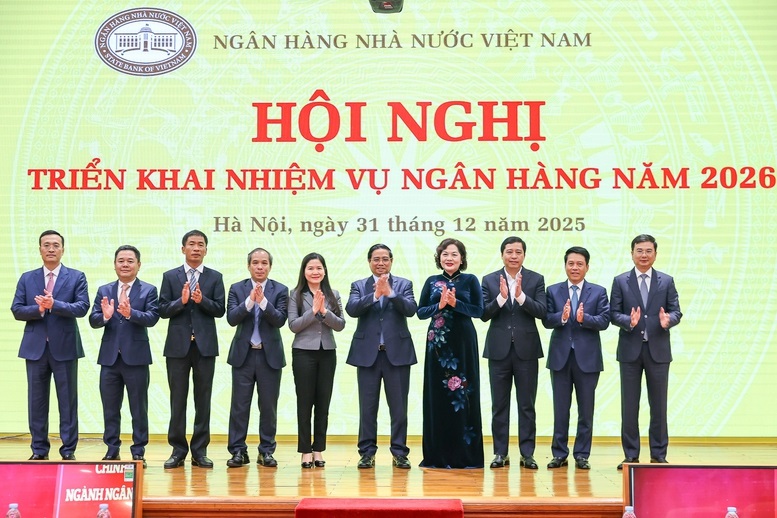 The Prime Minister takes a commemorative photo at the conference – Photo: VGP/Nhat Bac
|
The banking sector and the SBV should continue improving internal operations, focusing on organizational restructuring, digital transformation, high-quality human resource training, and building a competent, virtuous, dedicated, visionary, and energetic banking workforce. Emphasizing that “resources stem from thinking and vision, motivation from innovation and creativity, and strength from the people and businesses,” the Prime Minister expressed hope that with the motto “look far, think broad, act big” and the spirit of “proactiveness, flexibility, creativity, and efficiency,” the banking sector will continue its pioneering role, especially in science, technology, digital transformation, and smart management, striving for even greater achievements in 2026 compared to 2025.
At the conference, on behalf of the Party and State leaders, Prime Minister Pham Minh Chinh awarded the Labor Order, the title of National Emulation Warrior, and the Prime Minister’s Certificate of Merit to several individuals in the banking sector.
– 13:38 31/12/2025
Q4/2025 Earnings Estimates for 63 Top Stocks: SSI, VPB, KBC, MWG, PLX, POW Projected to Soar, One Company Set to Surge 600% in Profits
Numerous businesses are forecasted to achieve profit growth in Q4, with increases ranging from several dozen percent to even doubling compared to the same period last year.
Stock Market Welcomes the New Year with a Spectacular Fireworks Display

Closing today’s trading session (December 31), the VN-Index reached its highest year-end close at 1,784 points. Since the beginning of the year, the VN-Index has surged by over 517 points, marking its best performance since 2017.
Hai Phong Port Targets Pre-Tax Profit of Over VND 1.5 Trillion by 2026

On the morning of December 30th, Hai Phong Port Joint Stock Company (UPCoM: PHP) held an expanded meeting of its Party Executive Committee to review the work of 2025 and outline tasks for 2026. The company is entering a new phase of development, focusing on deep-water ports and comprehensive digital transformation.
December 30th Currency Market Update: Overnight Interest Rates Plummet to 3%, Halving Since Last Week
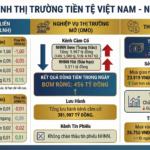
At the close of trading on December 29, the Vietnamese Dong (VND) interbank interest rates saw a sharp decline in the overnight term, while longer-term rates remained elevated. The State Bank of Vietnam continued its net liquidity injection through the Open Market Operations (OMO) channel. Both the central exchange rate and the USD rates across markets experienced a slight downward adjustment.
Gold Prices Plunge Further Tonight
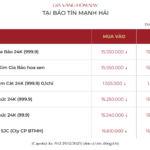
Gold prices have plummeted by 2 million VND per tael, pushing the historic peak of 160 million VND further out of reach!