











Instead of solely focusing on green products or price incentives, it is the accessibility, time-saving, and reduced transaction costs in reuse, return, and packaging recycling activities that hold the potential to shift consumption models from linear to circular on a large scale.
From Unlimited Convenience to Sustainable Convenience
“Convenience” has become a defining choice trend in modern consumer economics. According to the OECD’s 2022 EPIC survey, availability, affordability, and convenience are identified as the primary factors determining whether households adopt environmentally friendly choices[1].
However, when “convenience” is prioritized above all, consumers tend to accept a linear consumption model, exploiting resources, producing, and quickly discarding, rather than reusing or extending product lifecycles. This places increasing pressure on resources and the environment.
The UNEP’s 2024 Global Resources Outlook report shows that global resource consumption exceeds 100 billion tons of materials annually. If current trends continue, the global economy is projected to increase by 60% by 2060, exacerbating the triple planetary crisis of climate change, biodiversity loss, and pollution[2].
In Vietnam, this pressure is most evident in the e-commerce sector. In 2023, the online retail market was estimated at $17.3 billion, using approximately 332,000 tons of packaging, of which 171,000 tons were plastic. Projections indicate that by 2030, plastic waste from e-commerce alone could reach 800,000 tons without intervention[3].
Retailers favor plastic packaging due to its lower cost and reduced shipping fees because of its lightweight nature. About 90% of fashion and apparel retailers use plastic packaging. Approximately 35% of packages include foam inserts, and 30% use bubble wrap for impact protection. Most parcels are sealed with plastic tape[4].
The shift from “convenience at all costs” to “sustainable convenience” requires a redefinition of policy approaches. Instead of viewing convenience solely as a driver of harmful consumption, policymakers, businesses, and organizations are exploring how to leverage convenience to promote sustainable consumer behavior. The OECD’s 2025 “Mind Shift, Green Lift” report highlights that governments are increasingly applying behavioral science tools to encourage the use of sustainable goods, services, and technologies while phasing out unsustainable consumption models[5].
When Convenience Strains Sustainability
While households show willingness to adjust behavior for environmental benefits, significant barriers remain.
The OECD’s 2023 EPIC survey revealed that affordability remains a major obstacle. When purchasing food, consumers prioritize affordability (64%), followed by taste (61%), freshness (60%), and nutritional value (54%), while environmental impacts are considered less important, even among environmentally conscious consumers.
In transportation, only 54% of conventional car users said they would drive less if public transport improved in frequency, coverage, and cost. Additionally, 33% of respondents reported no electric vehicle charging stations within 3km of their homes, a significant barrier to EV adoption[6].
In a context of insufficient environmental information and greenwashing, consumer trust erodes, making them more cautious about “sustainable convenience” models. The OECD’s 2025 report, “Protecting and Empowering Consumers in the Green Transition,” emphasizes that strengthening green consumer protection policies, standardizing environmental claims, and using behavioral science tools to adjust consumption defaults are key priorities in the green transition[7].
Global Models of Sustainable Convenience
Pioneering companies worldwide are proving that convenience and sustainability are not mutually exclusive. According to the Ellen MacArthur Foundation, replacing just 20% of single-use plastic packaging with reusable models globally could unlock a $10 billion market opportunity.
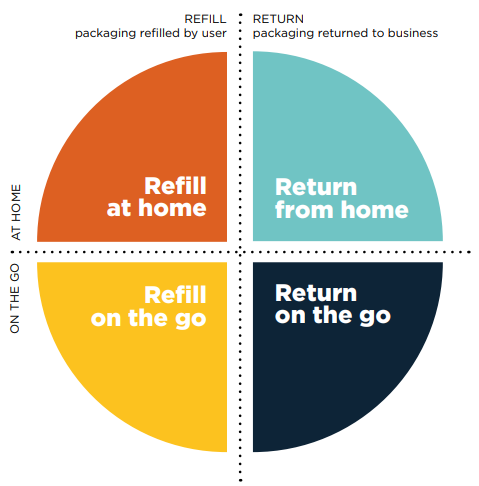
The report highlights six key benefits of reusable packaging: reduced costs through concentrated products and optimized transportation; customer data collection via RFID tags and sensors; operational optimization through standardized packaging and shared logistics infrastructure; increased brand loyalty through deposit-refund programs; customization options for consumers; and enhanced user experience through improved design and functionality. The report identifies four effective reuse models[8]:
Source: Ellen MacArthur Foundation
|
· Refill at Home: Consumers purchase a durable container and refill it with concentrated or compressed products at home. This model is particularly suitable for online channels, where businesses can offer integrated packaging-product solutions without competing for shelf space. Compact refills reduce packaging and shipping costs, while consumers benefit from lower prices and easier storage.
· Refill on the Go: Consumers bring their containers to refill stations in stores or public spaces. This model is ideal for traditional retail and urban environments, applicable to beverages, dry foods, oils, personal care products, and even takeaway coffee. Businesses benefit from reduced packaging and shipping costs, while smart refill systems provide valuable consumer behavior data.
· Return from Home: Linked to e-commerce, customers receive products in reusable packaging, which is collected by delivery services after use. This model is efficient in urban areas with dense delivery networks. Businesses clean, refill, and reintroduce packaging into the cycle, reducing waste.
· Return on the Go: Consumers purchase beverages or food in returnable packaging, which is returned to stores or collection points for cleaning and reuse. Deposit-refund mechanisms encourage returns and enhance brand loyalty.
Building a Sustainable Convenience Strategy in Vietnam
Vietnam has established a comprehensive policy framework through the National Action Program on Sustainable Production and Consumption for 2021-2030 (Decision 889/QĐ-TTg, 2020)[9]. This framework aims to reduce material consumption by 5-8% in key industries by 2025 and 7-10% by 2030.
To integrate “convenience” into these policies, Vietnam should focus on three strategic areas:
First, modern retail and e-commerce should develop compact refill models, integrated with mobile apps for customer tracking and rewards. The 2023 Ministry of Industry and Trade’s Logistics Report emphasizes digital transformation as a priority, reducing logistics costs through optimized transportation and enhanced supply chain connectivity[10].
Second, urban services should include accessible recycling infrastructure, such as water refill stations and circular packaging collection systems operated through public-private partnerships.
Third, financial institutions should support green consumption through green credit programs, cashback incentives, and rewards for reusing products and packaging.
By seamlessly integrating “convenience” into development policies, Vietnam can turn “green convenience” into a competitive advantage: businesses gain sustainable models, investors find long-term opportunities, consumers enjoy better services, and the environment benefits from reduced waste and resource pressure.
[1] https://www.oecd.org/en/publications/how-green-is-household-behaviour_2bbbb663-en.html
[2] https://research.csiro.au/circulareconomy/global-resources-outlook-2024/
[9] https://datafiles.chinhphu.vn/cpp/files/vbpq/2020/06/889.signed.pdf
[10] https://valoma.vn/wp-content/uploads/2023/12/Bao-cao-Logistics-Viet-Nam-2023.pdf
– 09:00 08/12/2025
$28 Billion: Vietnam’s Launchpad to Achieve Millennium Goals
To secure this massive capital, Vietnam must undertake a comprehensive and concerted effort.
Prime Minister Pham Minh Chinh: Green Transition in the Digital Age is an Inevitable Trend
Embracing green transformation in the digital age is an inevitable trend, an objective necessity, and a strategic priority for achieving rapid and sustainable development.
Café Amazon Shutters All Stores: Expert Nguyen Thai Binh Highlights Vietnam’s Unique “4F” Market Dynamics Foreign Chains Must Grasp

Renowned F&B expert Nguyen Thai Binh has shed light on the underlying reasons behind the struggles faced by foreign food and beverage chains, while also forecasting which segments stand to benefit from the void left by Amazon’s departure.
Unlocking Sustainable Economies: The Carbon Credit Market as the Green Asset Frontier
Carbon credits are emerging as a highly promising “green asset” in the global trend of sustainable growth and green transformation.
PBP Targets Nearly VND 9 Billion in Post-Tax Profit by 2026
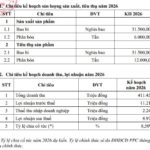
On November 17th, the Board of Directors of Vietnam Petroleum Packaging Joint Stock Company (HNX: PBP) approved the 2026 production and business plan. The company aims to produce 31.5 million packaging units and 6,000 tons of fertilizer, with a sales target of 31.5 million packaging units and 12,000 tons of fertilizer.