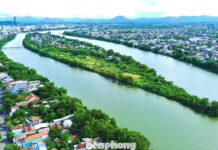





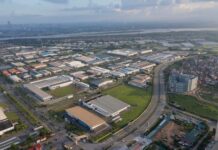












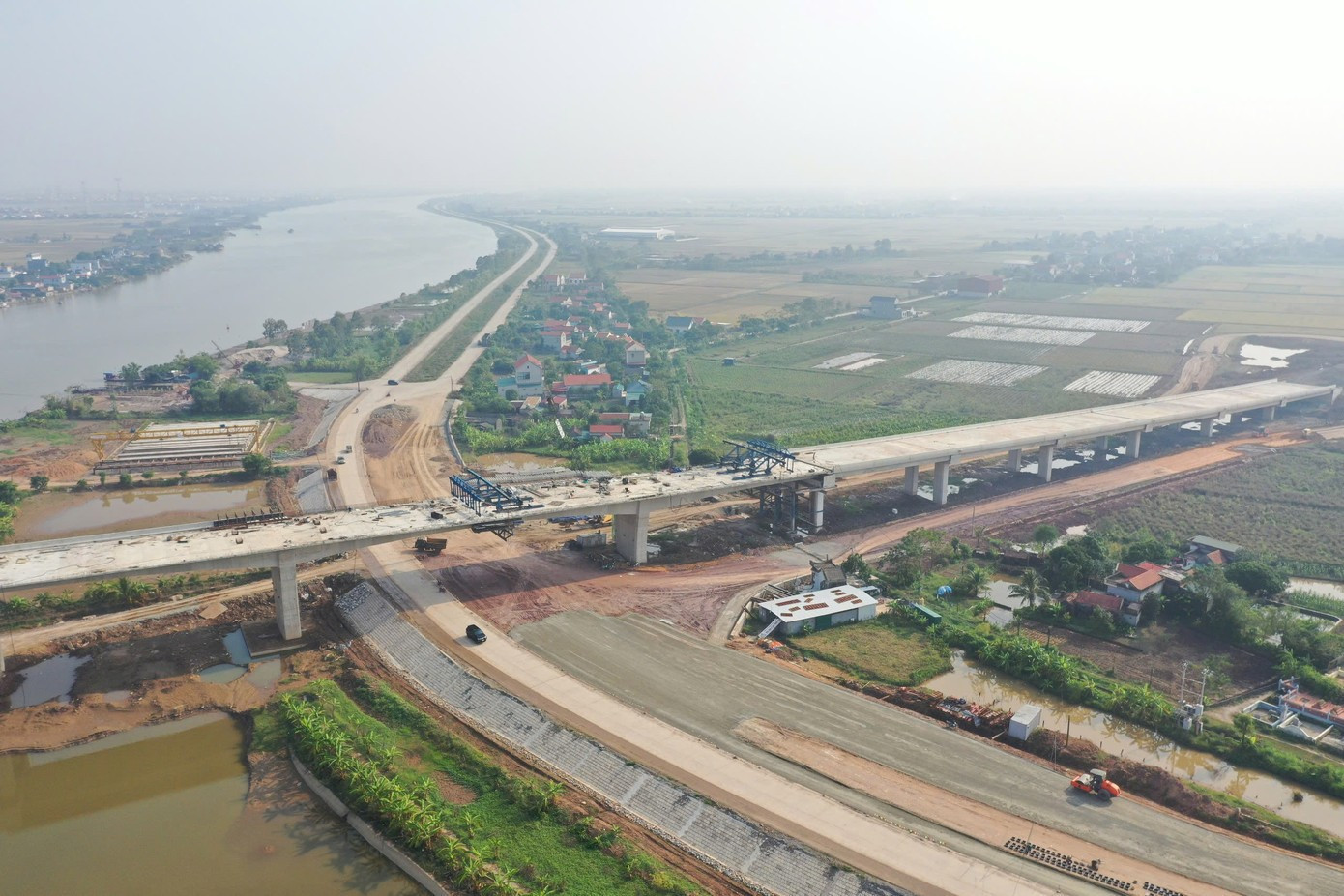
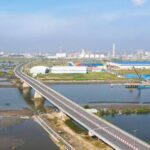
The nearly VND 1,500 billion Dau River crossing. Photo: M.D
Vice Chairman of the People’s Committee of Ninh Binh province Tran Anh Dung has just inspected and surveyed the landscape road combined with the dike along the Dau River, from Non Nuoc Bridge to Ben Moi Bridge.
This is part of a larger orientation to improve the urban landscape, expand the development space, and effectively exploit the potential and advantages of the province after the merger.
The road is oriented to play a role not only as a dyke and flood prevention measure but also as a typical landscape architectural work, bearing the unique identity of Ninh Binh city. The surveyed area includes the right bank of the Dau River (through Hoa Lu and Tay Hoa Lu wards) with a length of 13.1 km from Gian Khau Bridge to Tran Nhan Tong Street; and the left bank of the Dau River (through Phong Doanh and Y Yen communes) with a length of 13.7 km from the intersection of Hoang Long and Dau rivers to the CT.01 expressway.
Ninh Binh province expects the project to become a landscape highlight, serving economic and urban development while creating an attractive tourist destination along the river.
Vice Chairman of Ninh Binh province Tran Anh Dung emphasized that the investment needs to be well prepared, ensuring efficiency, feasibility, and full compliance with legal regulations. The People’s Committee assigns the Department of Construction to urgently review and propose adjustments to related planning, build at least two investment plans with clear phases, and analyze the advantages and disadvantages of each plan as a basis for appropriate selection.
The road should not only serve transportation and urban connectivity needs but also harmonize with cultural and architectural indigenous factors, ensuring national defense, security, environmental protection, and acting as a driving force for industries such as industry, services, and tourism.
Especially, the provincial leader requested an architectural design competition to select a symbol for the entire area. Ninh Binh province encourages creative ideas that will become a long-lasting symbol for the riverside city and potentially become an attractive destination for tourists. The Department of Agriculture and Environment is assigned to coordinate with related units to inspect and review the current status of hydraulic and dyke works along the Dau River; strictly handle violations in accordance with regulations. At the same time, coordinate with the Ministry of Agriculture and Rural Development to obtain technical advice on flood prevention and dyke safety elements in the design plan.
People’s Committees of communes and wards through which the route passes, such as Hoa Lu and Y Yen, are requested to tightly manage land and construction in the area, resolutely preventing encroachment, speculation, and policy exploitation; while reviewing land use status to propose effective land fund exploitation plans, serving socio-economic development.
The Ultimate Contractor Unveiled: Constructing a Mega Bridge Worth 3,400 Billion VND, Connecting Hanoi and Phu Tho, Bringing Joy to Millions
A lucrative contract worth an estimated $2.5 billion is up for grabs at the Van Phuc Bridge project, which is currently in the bidding phase.
The High-Speed Rail Link: Revolutionizing Transport from Ho Chi Minh City to Cai Mep, Bau Bang, and Can Tho
The Becamex Corporation has proposed an innovative and cost-effective solution to enhance transportation links across Vietnam. Their vision includes a high-speed rail network connecting Ho Chi Minh City with Cai Mep, Bau Bang, and Can Tho. This efficient transport system is set to revolutionize logistics, offering a staggering potential savings of 2.2 billion USD in logistics costs.
The Green Real Estate Boom: Unveiling the Unexpected Surge in Northern Eco-Property Prices.

Nestled amidst pristine nature, with its picturesque landscape and well-planned development focused on sustainability, the real estate market in Hoa Binh (now part of Phu Tho after a merger) is emerging as an attractive investment destination.
The Great Challenge for Vietnamese Businesses: Embracing Automation and AI in Manufacturing

“Even seemingly minor issues, such as loose, broken, or rusted bolts and screws, can significantly impact the customer experience. Businesses may spend tens of millions of dollars annually on component replacement and repairs.”
The New City: Unveiling the 2,000 Billion VND Project on 90 Hectares of Land in Khanh Hoa

The authorities of Dien Lac Commune, Khanh Hoa Province, have unveiled plans to reclaim nearly 90 hectares of land for the development of the Dien Khanh Administrative Urban Area (former name). With a total investment of over VND 2,000 billion, the project is undertaken by VCN Joint Stock Investment Company.